
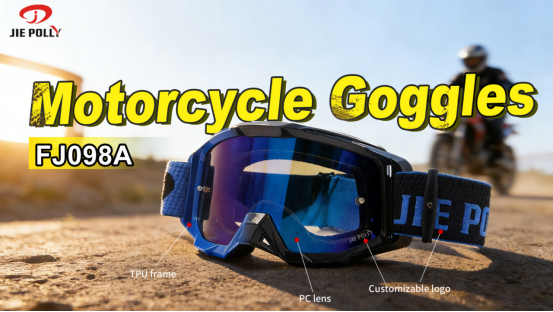
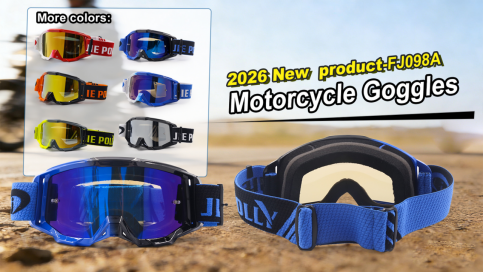
Jiepolly has launched a Newest motocross goggles
Given the unique conditions of motocross, the core logic for choosing goggles is entirely function-driven: in sunny weather, prioritize glare
protection and impact resistance; in dusty weather, prioritize sealing and sand protection; and in forest trails/damp and cold weather, prioritize anti-fog and light transmittance. This has little to do with the "electrochromic" and "AI recording" emphasized in your previous discussion
of "2026 Sports Trends"—motocross prioritizes physical protection, anti-fog ventilation, and helmet compatibility.
The following are specific goggle selection guidelines based on different riding conditions, all based on professional motocross media and
product specifications:
II. Selection Guide by Riding Condition
1. Sunny/Desert/Sun-Exposed Environments
Typical Scenarios: Summer motocross, gravel roads, unshaded tracks, desert riding.
Core Requirements: Strong light protection, anti-glare, impact resistance, sand and dust sealing.
Selection Points:
Lens Color: Black/Gray/Silver Lens. Gray provides optimal color accuracy, suitable for high-speed road judgment; the silver mirror surface additionally reflects infrared light, reducing internal lens temperature.
VLT (Visible Light Transmittance): Choose lenses with a low transmittance of 8%-20%. For example, the Rudy Project Spinshield Pro has a minimum VLT of 8%, ideal for bright light environments.
Ventilated Foam: Closed-cell foam is essential. Open-cell foam is quickly clogged by dust in the desert, while closed-cell foam (such as FOX Vue X) effectively prevents sand particles from entering.
Anti-fog Requirements: The risk of fogging is low in this environment; prioritize the scratch resistance of the mirror coating.
Representative Products: Rudy Project Spinshield Pro (excellent performance in sunny weather, ultra-lightweight at 24 grams, but its VLT range does not cover low light); FOX Vue X (closed-cell foam, specializing in sand and dust protection).
2. Dust/Mud/Sand Environments
Typical Scenarios: Following other vehicles, dry riverbeds, muddy tracks after rain, paintball/military-style off-roading.
Core Requirements: Extreme sealing, quick lens replacement, and protection against mud and water smudges.
Selection Considerations:
Face Material: TPU flexible frames conform better to facial contours than ordinary rubber, preventing dust from seeping in from the edges.
Lens Locking System: Lenses wear out extremely quickly in dusty environments. Choose a system that supports tool-less replacement, such as FOX's TruLock™ system or Alpinestars' plug-and-play design, allowing for quick replacement of clear or worn lenses between stages.
Exhaust Design: Forced ventilation, not passive ventilation, is required. Alpinestars Supertech's 100 PPI vents actively guide airflow, reducing fogging and dust accumulation inside the lens.
Nose Protection: A removable nose shield is optional to prevent branches or rocks kicked up by other vehicles at high speeds from hitting the bridge of the nose (Leatt 6.5 optional accessory).
Representative Products: Alpinestars Supertech Vision (high-density ventilation holes, sweat-wicking channels); Leatt Velocity 6.5 (military-grade ballistic protection standard, 170° wide field of view, mud and water resistant self-draining design).
3. Forest Trails/Shadows/Cloudy Days/Dusk
Typical Scenarios: Trekking through forests, tunnels, rainy days, early morning and evening training.
Core Requirements: Quick adaptation to light changes, high light transmittance, anti-fog.
Selection Considerations:
Lens Technology: Photochromic lenses are the best solution for forest trails. They require fast color-changing response and sufficient darkness in dark areas and sufficient transparency in light areas. Note: Some photochromic lenses fade and become less transparent in forest shade; for example, the Rudy Spinshield Pro is still too dark at the 48% VLT limit and is not recommended for dense forests.
**Very Low Light Transmittance (VLT):** Must cover a high-transmittance area of over 50%. Alpina Turbo Pro V's VarioFlex lenses are nearly transparent in low light, making them the preferred choice for forest trails.
**Lens Color:** Yellow/orange lenses enhance contrast, making tree roots and rock outlines clearer; clear lenses are the only option for nighttime forest trails.
**Anti-fog Performance:** An anti-fog coating or dual-lens lenses are essential. Forest trails are prone to fogging due to high humidity and strenuous activity. FOX Vue X's dual-lens structure is a proven solution.
**Representative Products:** Alpina Turbo Pro V (photochromic range covers 1-3 levels, extremely high brightness in low light, effective anti-fog coating); FOX Vue X (dual-lens, anti-fogging in humid weather).
4. High Altitude/Snowy Mountains/Extreme Cold
**Typical Scenarios:** High-altitude off-roading, snowmobiling, winter forest trails.
**Core Requirements:** Protection against snow blindness (high UV), protection against low-temperature cracking, and prevention of breath icing.
Key Selection Points:
UV Protection: UV400 is a must. Snow reflects over 80% of UV rays, and ordinary sunglasses can easily cause snow blindness.
Frame Material: Avoid ordinary PC frames that become brittle at low temperatures. TR-90 or nylon/ABS composite frames are more resistant to low-temperature impacts.
Ventilation and Freeze Protection: Special ventilation design is required. Historically, there were Venturi Effect goggles (Vents Goggles), which used negative pressure to draw away moisture and prevent frost from forming inside the lens. This was a brilliant design for extremely cold environments, but the brand has discontinued it; it can be used as a reference for selection principles.
III. The "Universal Compatibility" Principle for Motorcycle Off-Road Goggles
Regardless of riding conditions, motorcycle off-road goggles have three non-negotiable "universal compatibility criteria":
Helmet Compatibility: A tapered custom frame must be selected. Off-road helmets come with varying front opening angles, with professional models like the Leatt 6.5 specifically emphasizing compatibility with difficult-to-fit helmets. Meanwhile, a 45mm silicone strap with a 13° wedge design (like the Alpinestars) prevents the glasses from shifting during high-speed impacts.
Field of View: Off-road riding requires observing the front wheel's trajectory and distant obstacles. 170° WideVision is the professional-grade threshold, reducing A-pillar blind spots. The FOX Vue X and Alpinestars Supertech both emphasize "maximum peripheral field of view."
OTG Design: Nearsighted riders need to confirm that their frames support Over-The-Glasses (worn over prescription glasses). The Leatt 6.5 explicitly states OTG compatibility.
