
Why Single-Layer Ski Goggles Are Prone to Fogging
As a professional ski goggle manufacturer, JIEPOLLY clearly distinguishes the application scenarios of single-layer and double-layer lenses
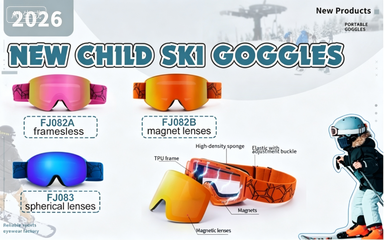
to meet differentiated market demands. Single-layer lens goggles are widely adopted in children’s entry-level ski goggles for their cost-effective and lightweight advantages, helping customers control bulk procurement costs. However, for adult professional skiing, snowmobile
and long-time outdoor snow sports, double-layer lenses have become the industry standard, mainly because single-layer structural defects
make them inherently prone to severe fogging.
1. Fundamental Structural Defect of Single-Layer Lenses
Fog formation on ski goggles is caused by temperature difference and air condensation. During skiing, human body produces heat and hot humid breath accumulates inside the goggle cavity, while the outer lens surface is exposed to freezing cold wind and low snowfield temperatures.
A single-layer lens has no insulation buffer layer. The thin single panel directly connects the warm inner air and cold outer air. Once the temperature gap forms, water vapor instantly condenses into tiny water droplets on the inner lens surface, resulting in persistent fogging that cannot be eliminated effectively.
2. No Dry Air Barrier (Core Advantage of Double-Layer Lenses)
Our standard adult double-layer goggles adopt a sealed hollow air insulation layer between the inner and outer lenses. This fixed dry air layer acts as a professional thermal barrier, isolating the internal hot humid air and external cold air. It balances the temperature on both sides of the lens, fundamentally preventing condensation and fog generation.
In contrast, single-layer goggles completely lack this buffer structure. Even with upgraded anti-fog coating, they can only reduce minor mist temporarily but cannot solve structural fogging, especially during long-hour skiing and strenuous exercise.
3. Limited Effect of Anti-Fog Coating on Single-Layer Lenses
Many customers mistakenly believe that high-quality anti-fog coating can completely solve single-layer fogging. In fact, anti-fog coating only improves the hydrophilicity of the lens surface to spread water droplets into a thin water film. It is a passive anti-fog solution.
In high-humidity and large temperature difference snowfield environments, the coating will quickly reach saturation. For adult high-intensity skiing scenarios, passive anti-fog technology is far from enough, while double-layer structure realizes active anti-fog from the source.
4. Reasonable Scenario Matching: Single-Layer vs Double-Layer
Single-layer ski goggles are the optimal cost choice for kids, beginners and short-time recreational skiing. With low usage intensity and short outdoor time, occasional slight fogging will not affect basic use, greatly reducing bulk purchase cost for distributors and ski resorts.
Double-layer ski goggles are mandatory for adult professional skiing, night skiing, snowmobile riding and long-time outdoor sports. The stable anti-fog performance ensures unobstructed vision, improves sports safety and meets high-end market and long-term rental equipment standards.
Factory Professional Suggestion
At JIEPOLLY, we provide customized lens solutions for different customer positioning. We support cost-effective single-layer lens schemes for children’s goggle bulk orders and standard high-performance double-layer lens schemes for adult models. We strictly follow industry application standards to balance cost control and product practicability, helping global wholesale customers achieve precise market layout.
