
Complete Guide to Ski Goggles: What to Look for and Key Features
Whether you’re carving down groomed beginner runs, navigating backcountry powder, or competing in park events, the right pair of ski
goggles is one of the most critical pieces of gear you’ll own. Beyond just keeping snow out of your eyes, quality goggles protect you from
harmful UV radiation, improve visibility in variable conditions, and prevent fatigue that can ruin a full day on the mountain. With dozens of
options on the market, from budget-friendly entry-level pairs to high-end premium models, understanding what key features to prioritize
will help you narrow down your choice and find a pair that fits your needs and budget.
Lens Technology: The Most Critical Feature
Lens quality is the foundation of any good pair of ski goggles, and there are three core factors to evaluate: UV protection, visible light transmission (VLT), and anti-fog performance. First, always confirm that your goggles offer 100% UVA and UVB protection. Snow reflects up to 80%
of the sun’s UV radiation, which means unprotected eyes are exposed to far more harmful rays than they would be at sea level, increasing
risk of long-term damage and temporary snow blindness. No matter the price point, 100% UV protection should be non-negotiable.
Next, consider VLT, which measures how much light passes through the lens. For bright, sunny days on open slopes, look for low VLT ratings
between 5% and 20%—these darker lenses cut down on glare and reduce eye strain. For overcast, snowy, or dawn/dusk skiing, opt for high
VLT ratings between 30% and 80%; these lighter, often amber or rose-tinted lenses boost contrast and help you distinguish changes
in terrain when light is limited. Many intermediate to advanced skiers prefer goggles with interchangeable lenses, which let you swap lenses
to match the day’s conditions without buying an entirely new pair. For skiers who prefer convenience, fixed lens models with a medium VLT
(20-30%) work well for most everyday conditions.
Finally, anti-fog technology is essential for clear vision. Temperature differences between your warm face and the cold outside air create
condensation, which can cloud your lens mid-run. Quality goggles use two layers of lens construction (called dual-pane lenses) to reduce
condensation, paired with a permanent anti-fog coating on the inner lens. Avoid wiping the inner anti-fog coating with rough cloths,
as this can scratch or damage the treatment and reduce its effectiveness over time.
Fit, Compatibility, and Additional Features
Once you’ve narrowed down your lens options, fit and compatibility are the next key factors. Your goggles should fit snugly against your face without pinching your nose or temples, and the foam seal should sit evenly against your skin to keep snow and wind out. If you wear a ski
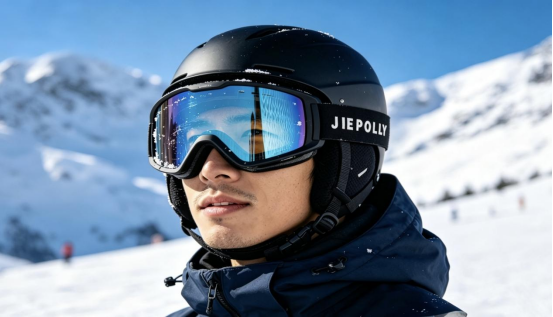
helmet (which you should), always look for goggles labeled as helmet-compatible—most modern
designs are built to integrate with helmet straps without leaving gaps or creating pressure points. It’s also important to match the frame size
to your face shape: wider frames with a larger field of view work best for larger faces, while narrower frames avoid gaping around the edges
on smaller or medium faces.
For skiers who wear prescription glasses, look for OTG (Over-The-Glasses) designs, which have extra space in the frame to fit comfortably
over your prescription lenses without pressure. If you frequently ski on bright, sunny days at high altitudes, polarized lenses are a great
upgrade—they cut down on horizontal glare from flat snowfields, making it easier to see subtle changes in terrain.
Other premium features to consider include scratch-resistant coatings (which extend the life of your lenses)
and spherical lens designs, which offer a wider, more distortion-free field of view compared to flat cylindrical lenses.
Final Thoughts
At the end of the day, the best ski goggles match your typical skiing conditions, face shape, and budget. Beginners don’t need to splurge on
a $500 premium pair, but investing in a quality pair with 100% UV protection and solid anti-fog will make your timeon the slopes farmore
enjoyable. By prioritizing the key features outlined in this guide, you’ll be able to pick a pair that keeps you safe, comfortable, and seeing
clearly for every run, all season long.
